
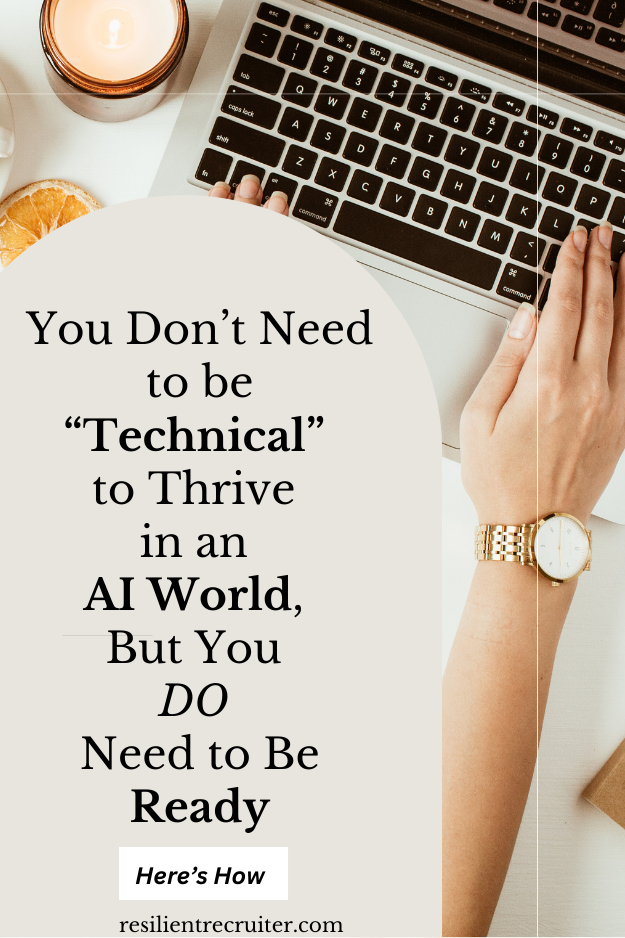
AI Literacy Isn’t Optional; It’s the New Career Currency for Non-Technical Professionals
You’ve probably heard the fear-mongering headlines: “AI will take everyone’s job.” The reality is far more subtle, but at the same time, far more career-changing. AI can do a lot of things, but isn’t here to replace you. It will, however, transform the nature of work. Your ability to adapt, to understand it, and to work with it is quickly becoming one of the strongest signals of your value in the job market.
We are living through a shift that’s bigger than remote work or cloud computing. AI is rewriting expectations for what all professionals (even those outside traditional tech roles) need to bring to the table.
The Shift: From Task-Based Roles to AI-Augmented Roles
In today’s workplace, AI doesn’t sit on the sidelines. It’s embedded in workflow systems that fundamentally shape how tasks are executed, decisions are made, and opportunities are recognized. Research from the World Economic Forum’s Future of Jobs Report 2025 shows that technological skills, including AI and data literacy, are projected to grow faster in importance than any other skill category over the next five years. Employers are no longer just hiring to fill a role; they’re hiring to ensure their teams can operate effectively with advanced tools and systems.
This doesn’t mean everyone needs to become a machine-learning engineer. What it does mean is that the baseline for future-readiness has changed. Middle-skill roles still exist, but they need to be reframed to include digital confidence and practical AI understanding.
What AI Literacy Really Means for Non-Technical Roles
When we talk about AI literacy for professionals outside software engineering, we aren’t talking about coding Python or building neural networks. We’re talking about being able to think with AI, use AI tools intelligently, and interpret AI output reliably.
The World Economic Forum argues that AI literacy “bridges gaps between technical and non-technical teams,” improving communication and outcomes across departments. In other words, teams that can speak a shared language with AI tools outperform those that avoid or misunderstand them.
Think of AI literacy like reading and writing in the digital age: once optional, it’s now assumed.
There are three practical components to this:
- Understanding what AI can and can’t do. You don’t need to build models, but you do need to understand how AI influences processes, insights, and decision support.
- Using AI to enhance your existing strengths. For example, automating repetitive tasks so you can focus on strategy, synthesis, or client interaction – the human work machines aren’t good at.
- Questioning outputs intelligently. AI isn’t perfect, and it can get things wrong. The real value comes from professionals who can question its output by knowing how to validate it, refine it, and interpret it in context. Those are the people whose decisions reflect real human judgment, not blind trust in a tool.
This perspective aligns with broader labor trends showing that human skills (especially communication, adaptability, and critical thinking) remain essential even as technical tools proliferate, according to Forbes.
My colleague, Amy Shannon, of Pinnacle Leadership Solutions, gave an excellent presentation at this year’s HR Star Conference on the critical elements AI will never possess – empathy being the greatest human-only attribute.
Adaptability Isn’t Soft; It’s Strategic
A few years ago, digital literacy meant knowing how to navigate spreadsheets and email. In 2026, the definition has expanded dramatically. McKinsey recently argued that we’re all techies now, noting that digital skill building isn’t just for IT specialists anymore. It is something essential for every employee in every function.
What does this look like in practice?
- A marketer who uses AI to generate audience insights and then crafts messaging that machines can’t replicate.
- A project manager who leverages automation to streamline reporting, freeing up time for stakeholder engagement.
- An HR professional who uses AI tools to analyze engagement data and inform retention strategy.
None of these require deep technical degrees. What they do require is the confidence to engage with tools, understand how insights feed into decisions, and think critically about what the tools are telling you.
That’s what future-readiness looks like: not just surviving automation, but collaborating with it.
Workflow Automation Doesn’t Replace Judgment, It Simply Reveals It
One of the biggest misconceptions is that automation will eliminate the need for human work. The real impact of automation is that it elevates the value of human judgment.
AI enables workflow automation by automating repetitive tasks, synthesizing large datasets, and streamlining communication. But automation only executes. It doesn’t interpret meaning, understand context, or navigate ambiguity. Those are human strengths.
A recent analysis by Boston Consulting Group highlights that companies increasingly evaluate candidates not just on technical knowledge, but on how well they use AI tools to solve real problems. That means adaptability, in this case, the ability to integrate new tools into your workflow, is now a competitive edge.
And unlike niche coding skills, adaptability translates across industries and roles. What doesn’t change is the value of human insight. This only becomes more visible when machines handle the routine.
Developing AI Literacy Starts With Intent, Not Intimidation
People often approach AI with one of two mindsets: fear or fantasy. Fear assumes machines will make humans irrelevant. Fantasy assumes AI will handle everything for us. Both mindsets miss the point. The truth is more nuanced and more empowering: AI amplifies what you do best, if you know how to use it.
AI literacy begins with curiosity and continues with practice. Here are some examples of where to start:
- Try the AI tools relevant to your work.
- Ask questions about how recommendations are generated.
- Use AI to test hypotheses, not replace thinking.
- Learn how to tailor prompts to get more relevant outputs.
The point of these exercises isn’t perfection. It’s confidence.
According to Salesforce’s analysis of workforce transformation, companies investing in AI literacy see measurable improvements in efficiency, decision quality, and competitive advantage, simply because their people know how to leverage the tools intelligently.
The Future-Ready Professional Isn’t Defined by Tech, But by Mindset
Here’s the lesson that separates career stagnation from career momentum:
Future readiness isn’t about being the most technical person in the room. It’s about being the most adaptable.
Technical fluency has become an advantage, but technical fearlessness is the true differentiator. Professionals who embrace digital confidence: by understanding tools, collaborating with automation, and trusting their judgment, will own the job market shifts that others find threatening.
AI isn’t a finish line. It’s a spotlight that will make visible the people who are willing not just to learn, but to evolve.
And that’s where your edge comes from.
What do you plan to do to upskill your AI confidence level? Leave a comment – I’d love to hear your thoughts.

by Natalie Lemons
Natalie Lemons is the Founder and President of Resilience Group, LLC, and The Resilient Recruiter and Co-Founder of Need a New Gig. She specializes in the area of Executive Search and services a diverse group of national and international companies, focusing on mid to upper-level management searches in a variety of industries. For more articles like this, follow her blog. Resilient Recruiter is an Amazon Associate.