
How to leverage emotional intelligence, inclusion and data-driven strategies to transform conflict into collaboration in a variety of work environments.
Conflict is inevitable in our personal and professional lives – a facet of our humanity. As I mentioned in my previous article on introverts and extroverts, we engage with many different personality types, each bringing unique expectations. For a leader in today’s workplace, it’s critical to identify brewing conflict early and act before it escalates.
Whether the issue arises between coworkers, a dissatisfied customer, or a negotiation stalemate, addressing negativity and conflict in a positive, professional way can salvage (and even improve) relationships, lift workplace morale, and boost productivity both individually and across the organization. When a heated scenario is resolved diplomatically and effectively, it enhances leadership credibility and respect.
The Most Common Conflict-Resolution Strategies
Here are the main approaches you’ll see – and how they fit (or don’t) in 2025.
- Accommodating – Giving the other party what they want. This strategy is often used when preserving peace seems more important than the outcome. While it can help in the short term, over-use may breed resentment or leave underlying issues unresolved.
- Avoiding – One of the least effective methods. Choosing to ignore or postpone a conflict rarely makes it disappear; instead the problem often grows unnoticed.
- Collaborating – Integrating the ideas of multiple parties with the goal of finding a creative solution acceptable to all. It’s ideal for complex issues but demands time and commitment.
- Compromising – Both sides give up parts of their positions to reach an acceptable (though perhaps not ideal) solution. Useful when parties hold roughly equal power and time is of the essence.
- Competing – A win-lose mindset: one side pushes hard to win, the other loses. This may be appropriate in emergencies or high-stakes, time-pressured situations – but over-use erodes trust and long-term relationships.
Each method has its place – but the key is choosing the right method for the moment, not defaulting to one style.
A Practical Protocol for Resolving Workplace Conflict (2025 Edition)
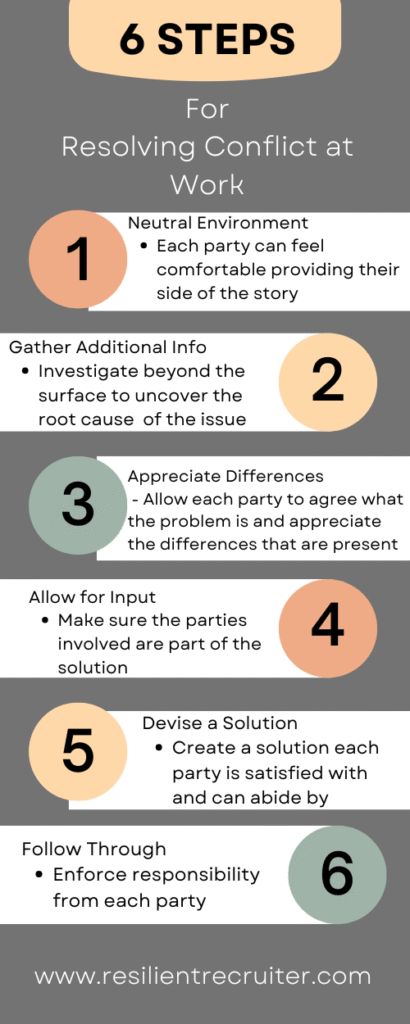
Here are updated key steps to ensure you handle conflict fairly, thoroughly, and in a way that reinforces your leadership:
1. Create a Neutral, Respectful Environment
Design a safe space where each party feels comfortable sharing their side. That means no blame games, no hidden agendas, and clear separation of the “issue” from the “person.” Document the discussion, restate to clarify, and ensure each side’s perspective is understood.
2. Gather Additional Information
What’s on the surface often isn’t the whole story. Investigate: Are the people from different departments with misaligned goals? Is this about personalities, power, or processes? Focus on one issue at a time. Clarify feelings (don’t assume). The deeper the root cause, the better the resolution.
3. Appreciate Differences
When you discuss the issue with each individual, use objective language (“I notice”, not “you always”). Recognize that perceptions will differ. Encourage each party to express their viewpoint and to hear the other. By creating understanding of differences, you increase empathy.
4. Allow for Input & Brainstorming
Once the problem is understood and differences acknowledged, invite all parties to co-create potential solutions. Encourage openness (with respectful ground rules). List every idea – even the “silly” ones. Together, evaluate, refine, and move toward consensus.
5. Devise an Agreement & Assign Responsibility
Turn brainstorming into an actionable solution. Clarify what each party will do and when. Document the commitments and monitor follow-through. Even if everyone doesn’t feel entirely “vindicated”, a fair process strengthens respect and shared ownership.
6. Follow-Up & Learn
After implementation, check back in. Did the solution work? What didn’t? What system changes (processes, team norms, communication practices) need to be made to prevent recurrence? Encourage a culture of continuous improvement.
Why Lead with This Mindset in 2025
The workplace today looks different than it did even a few years ago:
- In-person work environments have their own challenges, but hybrid and remote teams mean misunderstandings can emerge more easily – with fewer nonverbal cues, more asynchronous communication, and less spontaneous “water-cooler” conflict resolution opportunities.
- A heightened focus on inclusion, psychological safety, and belonging means leaders must be especially sensitive to identity, culture, and power dynamics in conflict.
- Change is rapid: technology, roles, business models – all are evolving. Stress, uncertainty and ambiguity are high. Simple friction can escalate quickly.
- Digital communication tools (chat, email, video) amplify misunderstanding yet also enable resolution – but only if used intentionally.
In short: the fundamentals of conflict resolution remain, but the context has shifted. Leaders need agility, emotional intelligence, and proactive practices more than ever.
For Further Reading & Learning
Turn the Tide: Rise Above Toxic, Difficult Situations in the Workplace, by Kathy Obear, Ed. D.
The Conflict Resolution Training Program: Leader’s Manual, by Prudence B. Kestner and Larry Ray
The Complete Guide to Conflict Resolution in the Workplace, by Marick F. Masters and Robert Albright
Conclusion
Conflict doesn’t have to be the enemy. In the complex workplace of 2025, the best-in-class leaders view conflict as a gateway to deeper connection, stronger teams and more resilient organizations. By choosing the right conflict-handling strategy, creating inclusive space, and following the protocol above – leaders can turn disruption into opportunity. Let today be the day you transform conflict into collaboration, growth and respect.

by Natalie Lemons
Natalie Lemons is the President of the Resilience Group, LLC, and the author of The Resilient Recruiter. Please follow her blog for more articles like this, plus helpful free downloads for recruiters or those starting a Recruiting business. Resilient Recruiter is an Amazon Associate.