
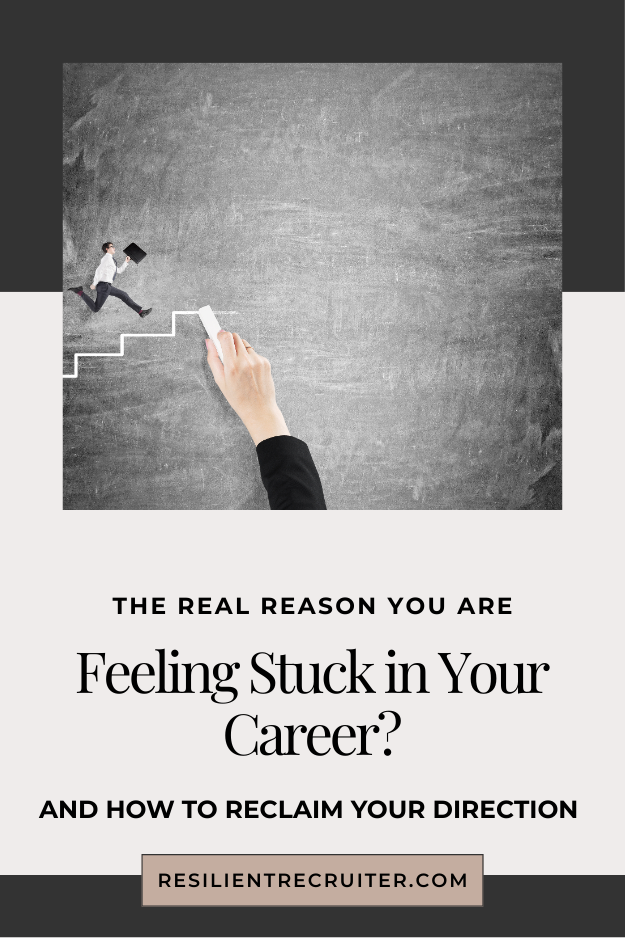
Here’s a topic almost no one talks about openly: you can be doing everything “right” in your career: earning promotions, delivering results, building credibility – and still wake up one day wondering why your work doesn’t feel like it used to.
You’re not burned out, ungrateful, or being dramatic. You’re stuck. Stuck feels confusing because nothing is wrong on the surface, yet something feels undeniably off underneath. This feeling is becoming increasingly common.
Gallup’s State of the Global Workplace 2024 reported that only one-third of employees felt engaged in their roles, even among high performers. And according to Harvard Business Review, mid-career stagnation is accelerating as industries shift, AI reshapes responsibilities, and professionals crave more meaningful, future-proof paths.
So if you’re sitting in a respected role at a respected organization, wondering, “Why doesn’t this feel like enough?” You’re not alone. And more importantly, you’re not stuck permanently.
A career rut isn’t a failure. It’s feedback. It’s a signal that who you’ve been and who you’re becoming are no longer fully aligned.
With the job market transforming (AI redefining workflows, hybrid expectations reshaping culture, and skills-based hiring opening new doors) this is actually the best moment to reassess your direction with clarity, strategy, and confidence. Here’s how to move forward with intention and momentum.
1. Reevaluate Your Current Situation (With Honesty and Precision)
Before you make a single move, you need clarity. Not the emotional kind, the strategic kind.
Ask yourself:
- What energizes me?
- What drains me?
- Is the misalignment about the work, the culture, or the trajectory?
- If nothing changed for the next two years, how would I feel?
MIT Sloan’s research on career satisfaction shows that lack of challenge, not salary, is the number one driver of stagnation. So your rut may have less to do with the company and more to do with the direction your role has taken.
This is where you get honest about whether you need a pivot within your organization, a new environment entirely, or a completely new path.
2. Step Back Before You Step Forward
This is the step most driven professionals skip. Deloitte’s Women @ Work report reinforces that people operating under chronic pressure struggle to make sound career decisions because self-awareness deteriorates under stress.
Translation: You cannot think clearly when you’re depleted. A pause is not indulgence; it’s strategy. Rest gives you back the perspective your role has taken from you. After you unplug, ask yourself:
“Was I unfulfilled because I was exhausted… or because this role no longer fits who I’m becoming?”
The answer is often very clear once the noise quiets.
3. Explore Your Alternatives Inside and Outside Your Organization
Career ruts often come from feeling boxed in, but the job market is more fluid than ever.
The World Economic Forum notes that skills, not job titles, are becoming the primary factor in hiring decisions. That means lateral moves, cross-functional shifts, and nontraditional transitions are not only possible… they’re increasingly preferred. This is the moment to explore:
- Teams you admire inside your company
- Cross-functional work that excited you
- Skills you’ve used informally that could be formal strengths
- Roles at other organizations where your work carries more meaning or impact
Sometimes your next move is one department over. Sometimes it’s one industry over. And in some cases, it’s a completely different chapter. The key is curiosity over certainty. Look broadly. Explore roles that use your strengths differently. Consider organizations where your work has more impact, autonomy, or creativity.
4. Expand Your Network (This Is Not Optional in 2026)
Networking is no longer a “nice to have”. It is now the infrastructure of modern career mobility.
LinkedIn’s 2025 Workplace Learning Report shows that nearly 80% of new opportunities originate from a professional network, not job boards. Networking today isn’t about collecting contacts. It’s about creating community.
Take the time and reconnect with former colleagues, attend industry gatherings, join those professional groups. Talk to people doing work you’re curious about. Networks can do much more than open doors. They reflect back possibilities you can’t see alone.
5. Drop the Habits That Are Quietly Sabotaging You
A rut isn’t always about your job. Sometimes it’s about your bandwidth. Research from the American Psychological Association shows that sleep, nutrition, and movement directly influence career decision-making and cognitive agility.
If your foundation is depleted, your ambition can’t thrive.
Small habit shifts: consistent sleep, fewer late-night emails, morning movement, digital boundaries, create more career clarity than you think. Your brain needs fuel to make your next move. It’s not glamorous, but it’s deeply effective.
6. Build a Strategic Plan, Not an Emotional Reaction
Once clarity returns, start mapping your move.
Harvard Business Review’s research on successful transitions shows that career change requires:
- A clear narrative
- Future-oriented skill building
- A realistic timeline
You are not making a reactive exit; you’re architecting your next chapter.
Ask yourself the following questions:
- What role do I want next?
- What skills does it require?
- How do I tell my story in a way that connects?
- Who can I learn from or collaborate with?
- What’s my timeline for testing this direction?
And whatever you do, do not burn bridges. It narrows future options – and in today’s connected world, your reputation travels farther than you think
7. Make the Move (and Embrace the Discomfort of Growth)
Growth will feel uncomfortable. That’s not a sign you made a mistake; it’s a sign you’re moving again. Whether you step into a new team, a new company, or an entirely new field, trust yourself to rise to the challenge. New environments bring fresh learning, renewed energy, and meaningful stretch.
And once you’re on the other side of the rut, you’ll recognize something powerful: it wasn’t a setback. It was an inflection point. And eventually, you’ll be the one helping someone else recognize theirs.
The Bottom Line
A career rut is not a stop sign; it’s a turning point. In a world shaped by AI, evolving skill demands, hybrid expectations, and non-linear career paths, your career will change. The question is whether it changes with your participation or without it.
You don’t need perfect clarity. You need honesty, strategy, and forward motion. Your next chapter might be more aligned, energizing, and more meaningful than anything you’ve experienced so far.
And this moment – the moment you identify where you are – is the moment the next version of your career begins.

by Natalie Lemons
Natalie Lemons is the Founder and President of Resilience Group, LLC, The Resilient Recruiter, and Co-Founder of Need a New Gig. She specializes in the area of Executive Search and services a diverse group of national and international companies, focusing on mid to upper-level management searches in a variety of industries. For more articles like this, follow her blog. Resilient Recruiter is an Amazon Associate.