
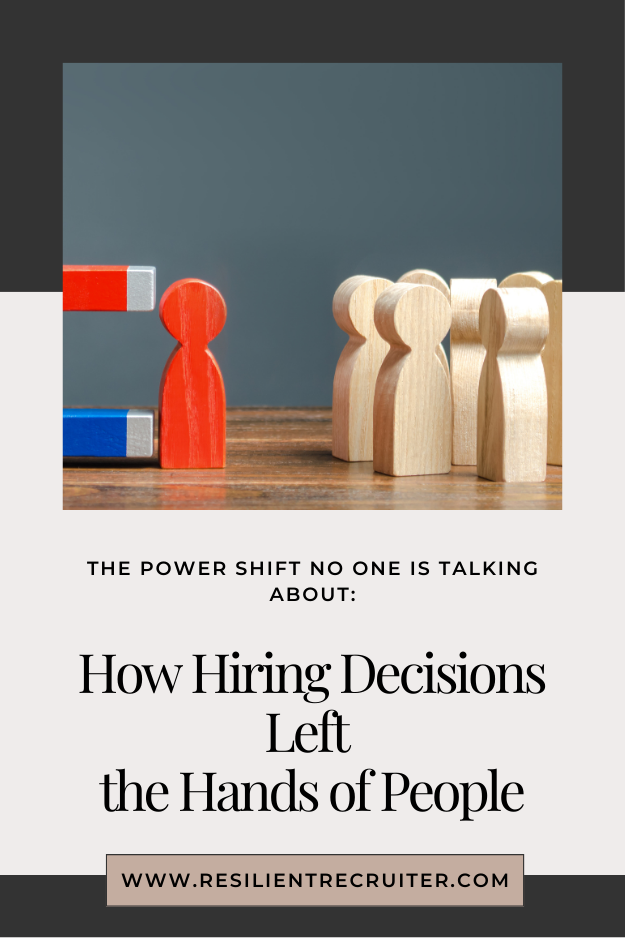
Something subtle but consequential has changed in hiring, and most professionals can feel it, even if they struggle to name it.
Decisions take longer. Momentum appears without commitment. Even responsibility as we know it seems everywhere and nowhere at the same time. What used to feel like judgment now feels procedural. What once hinged on a hiring manager’s call now drifts across systems, meetings, and approvals without ever fully landing.
Hiring didn’t become broken; it became distributed. As I’m sure you’re aware – this isn’t a good thing.
When Decision Authority Stops Sitting With One Person
Hiring decisions used to be anchored. A manager identified a need, assessed candidates, and made a call. Other inputs mattered, but authority was visible. That anchor has loosened.
Research from MIT Sloan Management Review on decision diffusion shows that as organizations scale and complexity increases, authority spreads horizontally. Decisions move from individuals to processes, from judgment to alignment. The goal shifts from choosing well to avoiding exposure.
Hiring is a textbook example of that shift. No single person fully owns the decision anymore, even when someone is nominally accountable for the outcome.
Why the Process Keeps Moving Without Resolution
From the outside, it’s baffling. Interviews happen. Conversations are thoughtful. Feedback sounds positive. And yet nothing resolves. Internally, the logic is different.
Modern hiring decisions often require concurrence across recruiting, leadership, finance, legal, and sometimes external stakeholders. Each group brings a different concern. None of them individually can authorize the risk of moving forward.
According to Gartner’s research on talent decision architecture, contemporary hiring systems are designed to reduce organizational exposure, not to accelerate individual judgment. The safest move, structurally, is to keep learning rather than to decide.
That’s how interviews continue even when commitment hasn’t formed.
How Technology Became the Stand-In for Judgment
Applicant tracking systems and formal processes didn’t replace human judgment because organizations stopped valuing people. They replaced it because systems provide cover.
A process can be defended. A system can be blamed. A committee diffuses responsibility. Therefore, the “risk” falls into no one’s lap individually.
Research from Oxford University’s Saïd Business School on institutional risk behavior shows that under scrutiny, organizations gravitate toward decisions that can be justified procedurally rather than personally.
Technology didn’t remove people from hiring; it only changed what people are allowed to be responsible for.
What Candidates Experience as Silence
For job seekers, this shift shows up as delayed responses, vague feedback, and extended timelines that never quite conclude. Translation: pain and anxiety added to an already difficult process.
That experience is often interpreted as disinterest or disregard. In reality, it’s usually uncertainty about authority. No one wants to communicate a decision that hasn’t actually been made – or commit language that could later be contradicted.
Research from CIPD on candidate experience points to this exact dynamic: communication breakdowns most often occur when internal alignment is incomplete, not when candidates are being intentionally ignored. Silence isn’t the message – indecision is.
Why Even Hiring Managers Feel Constrained
This loss of decisional clarity isn’t limited to candidates. Hiring managers increasingly carry responsibility without corresponding authority. They may champion a candidate, but still require approval across layers they don’t control. They may be asked to justify a hire long before they’re empowered to make one.
Work from McKinsey & Company on organizational velocity shows that when accountability and authority drift apart, decision speed slows dramatically. Hiring is one of the first places that slowdown becomes visible.
That’s why even well-intentioned leaders struggle to explain delays. The decision no longer belongs to them alone.
What This Shift Explains (and What It Doesn’t)
Understanding this power shift doesn’t make hiring feel fairer. It doesn’t reduce the emotional toll of waiting or uncertainty. What it does do is clarify what’s actually happening.
Delays are not always disinterest, positive signals are not always commitment, and, most sobering – strong interviews do not always lead to decisions.
As I’ve argued throughout ResilientRecruiter.com, many capable professionals misinterpret systemic hesitation as personal rejection. That misreading carries a real cost. This shift explains behavior; it doesn’t excuse it.
Why This Conversation Rarely Happens Openly
There’s a reason this dynamic isn’t widely acknowledged. Admitting that hiring decisions are system-bound rather than person-driven challenges familiar ideas about leadership, merit, and accountability. It’s easier to talk about optimizing résumés or interview performance than to acknowledge that judgment itself has been constrained.
But ignoring the shift doesn’t undo it.
Research from The Brookings Institution suggests that as organizations continue to manage scale, scrutiny, and risk, decision systems will only become more layered.
This is not a temporary phase. It is developing more into a structural change.
My Closing Thoughts
Hiring didn’t become impersonal because people stopped caring. It became this way because decisions no longer belong to any single person.
Understanding that distinction prevents capable professionals from attributing delay, silence, or ambiguity to personal failure when the cause is institutional design. Clarity on this topic won’t restore the old model, but it does create perspective – and maybe a signal for us to be a little bit easier on ourselves.
Discussion
For those involved in hiring:
Where do you feel decision authority ends, even when responsibility continues?
For job seekers:
At what point did it become clear that no one truly “owned” your hiring outcome?
I’m interested in perspectives from both sides of the table.

by Natalie Lemons
Natalie Lemons is the Founder and President of Resilience Group, LLC, and The Resilient Recruiter and Co-Founder of Need a New Gig. She specializes in the area of Executive Search and services a diverse group of national and international companies, focusing on mid to upper-level management searches in a variety of industries. For more articles like this, follow her blog. Resilient Recruiter is an Amazon Associate.