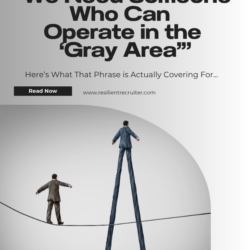
We need someone who can operate in the gray area. Here's what that phrase is actually covering for.

“We Need Someone Who Can Operate in the Gray Area.” Here’s What That Phrase Is Actually Covering For.

The Secret Language of Hiring, Part 13 It sounds like sophistication. It implies a complex environment, a high level of trust, and a role where judgment is valued over rigid process. In practice, “operate in the gray area” is covering for something specific in almost every case – and one of those versions is the[…]

"We're Just Wrapping Up Final Interviews". Here's What's Actually Happening Behind the Scenes.

“We’re Just Wrapping Up Final Interviews.” Here’s What’s Actually Happening.

The Secret Language of Hiring, Part 12 It happens right at the most anxious moment in any job search – after a final round, waiting for a decision. It sounds like forward movement and implies the finish line is close. But which version of it you actually receive determines everything about what you should do[…]

The team had some concerns. Here's what was really happening.

“The Team Had Some Concerns.” Here’s What Actually Happened in That Room.

The Secret Language of Hiring, Part 11 It feels like feedback. It implies a specific conversation took place, a standard was applied, and a thoughtful group of people weighed in on your candidacy. In almost every case, it is none of those things. Here’s what “the team had concerns” actually covers for, and how to[…]

We need someone who can wear many hats. Here's what that really means.

“We Need Someone Who Can Wear Many Hats.” Here’s What That Phrase Is Actually Telling You.

The Secret Language of Hiring, Part 10 It sounds like an opportunity. It implies variety, growth, the chance to contribute beyond a narrow job description. In practice, “wear many hats” is one of the most consistently misread phrases in the hiring process – and the version most candidates don’t identify until they’re already inside is[…]
We're Looking for Someone Who's a Culture Fit. Here's What That Really Means.

“We’re Looking for Someone Who’s a Culture Fit.” Here’s What That Actually Means.

The Secret Language of Hiring, Part 9 It sounds like a compliment. It implies the company has standards, a distinct identity, and a thoughtful approach to who belongs inside it. In practice, “culture fit” is one of the most overused, under-defined, and legally convenient phrases in the hiring process. Here’s what it usually means from[…]

The role has evolved since we last spoke. Translation: the job you applied for no longer exists.

“The Role Has Evolved Since We Last Spoke.” Translation: The Job You Applied For No Longer Exists.

The Secret Language of Hiring, Part 6 You made it through multiple rounds. You prepared meticulously. And then you were told the role “evolved.” Here’s what that word actually means from inside the organization, why it’s becoming more common in 2026, and what you should do when the ground shifts underneath a process you were[…]
We'll keep your resume on file - and other phrases that mean no.

“We’ll Keep Your Resume on File.” And Other Phrases That Mean No.

The Secret Language of Hiring, Part 5 There’s a particular kind of frustration that comes from a rejection that refuses to call itself one. These are the phrases that sound like they’re keeping a door open when the lock has already turned, and what you should actually do when you hear them. I want to[…]
"We decided to go in an different direction." What that actually means.

“We Decided to Go in a Different Direction.” What That Actually Means.

The Secret Language of Hiring, Part 4 It sounds like a decision was made thoughtfully. It implies you were genuinely considered. And it tells you absolutely nothing about what happened, why it happened, or what you could have done differently. Here’s what “a different direction” usually means from the inside. I want to start with[…]

The Position Has Been Put on Hold. What's Really Happening Behind the Scenes.

“The Position Has Been Put on Hold.” Here’s What’s Actually Happening Behind the Scenes.

The Secret Language of Hiring – Part 2 It sounds temporary, even organizational. And it’s designed to make you feel like the situation is about timing rather than about you. Here’s what “on hold” usually means from the inside, and why the professionals who handle it best are the ones who keep moving regardless. I[…]

"We're Still Interviewing Other Candidates". Here's What They're Really Telling You.

“We’re Still Interviewing Other Candidates.” Here’s What They’re Really Telling You.

The Secret Language of Hiring, Part 1 You prepared carefully, the conversation went well, and the feedback seemed positive. Then you heard five words that sound like a status update but almost never are. Here’s what’s actually happening on the other side of that phrase, and what it means for how you spend your time[…]

Companies are Cutting Jobs Based on What AI Might Do, not What It's Actually Doing. Here's What That Means for Your Career.

Companies Are Cutting Jobs Based on What AI Might Do, Not What It’s Actually Doing. Here’s What That Means for Your Career.

Nearly 300,000 jobs were cut in Q1 of 2026 alone, and more than half were labeled “AI-driven.” But a closer look at the data tells a very different story than the one most professionals are hearing. A client of mine, a senior operations director with 18 years of experience, was let go in February. The[…]

The career break penalty is real. But the reasons hiring managers believe in it are mostly wrong.

The Career Break Penalty Is Real. But the Reasons Hiring Managers Believe in It Are Mostly Wrong.

Harvard Business Review’s March/April 2026 issue featured a marketing executive who paused his career for a decade to homeschool his neurodiverse daughter, now contemplating how to reenter. His story captures something most career advice completely misses about what hiring managers actually fear when they see a gap on a resume. I want to start with[…]

What Recruiters Know About Silence - and Job Seekers Deserve to Hear

What Recruiters Know About the Silence – And Job Seekers Deserve to Hear

Between 1 in 5 and 1 in 3 job postings right now may never have been real. Here’s why companies do it, what it’s costing job seekers, and how to protect your time and energy without giving up on the search entirely. I want to start with something I hear regularly: a version of the[…]

What not to say in an interview - transform your responses for success

What NOT to Say in Interviews – Transform Your Responses for Success

Interviews can be nerve-wracking, but they’re also incredible opportunities to showcase your skills, personality, and fit for the role. However, the wrong words can sabotage your chances faster than you can say, “I’m a team player.” In this article, we’ll explore common phrases that can derail your candidacy and provide you with powerful alternatives that[…]

How to Research a Company Before an Interview (And Actually Show You Belong There)

How to Research a Company Before an Interview (And Actually Show You Belong There)

Most candidates walk into interviews thinking they’ve really done their homework, when chances are, they haven’t. They’ve read the website, scanned LinkedIn, and maybe glanced at a few recent articles. And then they sit down, answer questions well…and still don’t get the offer. And they wonder why. This had nothing to do with qualifications. The[…]

Why Companies Interview Candidates They Never Planned to Hire

Why Companies Sometimes Interview Candidates They Never Planned to Hire

Few experiences in a job search feel more confusing than this one: you prepare carefully for an interview. The conversation goes really well. The feedback all seems positive. And then… nothing. Weeks later, you learn the company hired someone else. Sometimes the role even appears to have been filled internally. It feels like a punch[…]

Why Job Hopping Hurts Your Career More Than You Think

Why Job Hopping Hurts Your Career More Than You Think

This may sound counter to the advice circulating online right now – and the workplace trend, especially for Millennials and Gen Z. For the past several years, frequent moves have been framed as leverage. Leaving for higher pay, better culture, or growth. Rinse and repeat. And in certain seasons of the market, that strategy works.[…]

Paying to be recruited: Is this the new norm?

Paying to Get Recruited Isn’t Innovation. It’s a Warning Sign for the Hiring Market.

For most of modern recruiting history, one line was clear: companies paid to find talent. They had existing budgets allocated for retained, contingent, and temporary recruiting services. Candidates did not pay to access opportunity. That structure existed for a reason: it kept accountability where the benefit lived. Now, unfortunately, that line is shifting. The term[…]

How to Tell if a Job is Really Remote

How to Tell if a “Remote Job” Is Actually Remote (Before You Accept the Offer)

The most misleading word in hiring right now isn’t “competitive,” “growth,” or “fast-paced.” It’s remote. Roles are posted on job boards as fully remote. The interviews are conducted remotely. Offers are extended remotely. And then, slowly, expectations shift. Travel increases. Office presence becomes “valuable.” Leadership begins talking about collaboration and visibility again. Within a year,[…]

How Salary Transparency Has Actually Changed Hiring Behavior

Salary Transparency Was Supposed to Empower Candidates. It’s Actually Changing Hiring Behavior.

For years, compensation was the quietest part of the hiring process. It surfaced late in the process, was negotiated privately, and most candidates entered conversations unsure of where they stood (or even how to ask for what they want). That is no longer true. Salary ranges are now appearing directly in job postings across the[…]

Interview Red Flags to Watch Out For (Before You Accept the Job)

The Interview Red Flags to Watch For (Before You Accept the Job)

The Interview Didn’t “Feel Wrong”, but Something Didn’t Add Up Most professionals no longer worry about whether they interview well. The greater fears plaguing them revolve around whether the role itself is stable, real, and worth stepping into. That shift is notable. For years, interview advice focused on performance: how to answer questions, build rapport,[…]

Why Beating the ATS Misses the Point

Why “Beating the ATS” Misses the Point

The ATS isn’t rejecting you. It’s preventing anyone from advocating for you, and sometimes it filters out good candidates for the wrong reasons. For years, candidates have been told that resumes disappear into a “black hole” or “application abyss” called an Applicant Tracking System (ATS). The narrative goes like this: if you don’t use the[…]

AI Didn't Level the Job Search - it Concentrated Power

AI Didn’t Level the Job Search; it Concentrated Power

AI didn’t make job searching easier. It made average candidates look identical, and standout candidates harder to spot. That’s a radical statement in a marketplace that popularized access. The narrative is that AI gives every job seeker high‑quality writing and friction‑free entry to opportunity. The reality is that a flood of algorithm-ready resumes is changing[…]

Why Hiring Will Never Go Back to Normal - and What That Means for Careers

Why Hiring Will Never Go Back to “Normal”, and What That Means for Careers

Whenever hiring slows or becomes more unpredictable, the same questions resurface: I’ve been through my fair share of uncertainty in the recruiting industry (post 9/11, the Great Recession, Covid, you get where I’m going). It’s an understandable fear. Most professionals want to believe the confusion they’re experiencing is an anomaly, something to endure rather than[…]

Why Job Search Burnout Feels So Different This Time

Why Job Search Burnout Feels So Different This Time

Most professionals don’t recognize job search burnout when it starts. They assume they’re tired, distracted, or losing motivation. They tell themselves they just need to be more disciplined, more positive, more resilient. So they keep going: applying, preparing, following up, even as the process begins to feel strangely hollow. What’s misleading is that this doesn’t[…]

AI Isn't Replacing Hiring; It's Changing What Humans Are Allowed to Decide

Why AI Isn’t Replacing Hiring; It’s Changing What Humans Are Allowed to Decide

The frustration people feel about AI in hiring isn’t really about technology itself. What seems to be emerging with the advent of AI/automation is the loss of traditional hiring dynamics. It may show up in a variety of ways: So many of the explanations I’m seeing blame machines: algorithms, screening tools, automated rejections. That story[…]

Why Overqualified Really Means Too Risky to Hire

Why “Overqualified” Really Means “Too Risky to Hire”

Few words in hiring feel as dismissive as overqualified. It usually lands without any further explanation and is rarely followed by any other feedback. It therefore leaves capable professionals questioning whether experience has somehow become a liability overnight. Most commentary treats this as insecurity on the employer’s side: fear of being outshined, threatened, or exposed.[…]

Why Some Candidates Never Apply - and Still Get In

Why Some Candidates Never Apply – And Still Get Hired

Most professionals eventually notice it. The same candidate names keep resurfacing. The same people seem to move between roles without ever “job searching.” They don’t post about applications. They don’t talk about networking. They simply appear – already trusted, already vouched for….. already inside the process. Meanwhile, equally capable professionals follow every recommendation. They apply[…]

How Hiring Decisions Left the Hands of People

The Power Shift No One Is Talking About: How Hiring Decisions Left the Hands of People

Something subtle but consequential has changed in hiring, and most professionals can feel it, even if they struggle to name it. Decisions take longer. Momentum appears without commitment. Even responsibility as we know it seems everywhere and nowhere at the same time. What used to feel like judgment now feels procedural. What once hinged on[…]

Why Career Advice Keeps Contradicting Itself...and Why That's Not an Accident.

Why Career Advice Keeps Contradicting Itself

…And Why That’s Not an Accident If career advice feels increasingly inconsistent, it’s not because you’re consuming the wrong content. The real reason is because the system that advice was designed to explain no longer behaves in a consistent way. Which one is correct? It can make your head spin! None of this advice is[…]

Why Job Searching Feels Harder - Even for Strong Candidates

Why Job Searching Feels Harder This Year – Even For Strong Candidates

Many capable professionals are discovering that the effort-driven job search strategies that once worked are no longer producing the same results. That concern is showing up consistently across search behavior and professional conversations. Job seekers report feeling unprepared for the realities of the 2026 market. Others describe putting in sustained effort while receiving limited traction or usable feedback.[…]

Why Networking Doesn't Work and What Employers Actually Respond To

Why Networking Advice Fails Most Professionals (And What Employers Actually Respond To)

Few pieces of career advice generate as much quiet resentment as this one: “You just need to network more.” For capable professionals, especially those with experience, judgment, and a track record, this advice doesn’t feel empowering. It feels dismissive. As if effort were the missing variable. As if they hadn’t already reached out, followed up,[…]

The Confidence Tax: What a Long Job Search Quietly Takes From You

The Confidence Tax: What a Long Job Search Quietly Takes From You

Most professionals don’t enter a job search worried about confidence. They worry about timing. About fit. About whether the market will cooperate. But they trust their judgment. They believe they can still read situations accurately, assess opportunities clearly, and recognize progress when it appears. What they underestimate is how confidence erodes without ever announcing itself[…]

Why Employers Still Interview When They're Not Ready to Hire

Why Employers Keep Interviewing When They’re Not Ready to Hire

For candidates, one of the most destabilizing experiences in a job search is not rejection. It’s momentum without resolution. The process advances. Interviews are scheduled. Conversations feel substantive. Signals are neutral-to-positive. And yet, no decision ever quite arrives. Weeks stretch into months. Explanations soften. Timelines blur. From the outside, this looks like inefficiency or indecision.[…]

Your Resume Isn't the Problem - the Role isn't Real Yet

The Resume Isn’t the Problem: The Role Isn’t Real Yet

When a resume fails to gain traction, the assumption is almost automatic: something about it must be wrong. Not targeted enough. Too senior. Too generic. Missing keywords. Overly polished or not polished enough. The list can go on (and on). The resume becomes the natural object of scrutiny because it is the only part of[…]

What Overqualified Really Means in Today's Hiring Market

What “Overqualified” Really Means in Today’s Hiring Market

Few phrases in the hiring process generate as much confusion as “overqualified.” It sounds like praise, but it functions as a full stop. Candidates are left wondering how experience, judgment, and capability – the very qualities careers are built on – suddenly became liabilities. Most explanations offered to candidates are superficial. Employers worry you’ll get[…]

Why Interview Feedback is Vague - and Why it Usually Has to Be

Why Feedback Is Vague – and Why It Usually Has to Be

For many candidates, the most frustrating part of the hiring process is not rejection itself. It is the explanation. After multiple interviews, careful preparation, and weeks of waiting, candidates are told some variation of the same thing: “It was a competitive process.” “We went in another direction.” “There was nothing wrong; it just came down[…]

Why Interviews Rarely Decide Who Gets Hired

Why Interviews Rarely Decide Who Gets Hired

You’ve likely had this experience: you walk out of an interview feeling confident. There’s good rapport. You hit every question. Yet weeks later, there is still silence. Or worse yet – rejection. If that’s happened to you more than once, you’re not imagining it. What feels like a good interview often has very little predictive[…]

What Employers Mean by "Fit" and What Candidates Keep Getting Wrong

What Employers Mean by “Fit” – and Why Candidates Keep Getting It Wrong

“Not the right fit” has become the most common explanation candidates hear – and the least understood. It is often interpreted as vague, personal, or dismissive. For many candidates, it feels like a soft rejection hiding a harder truth: we didn’t like you, you didn’t belong, or you weren’t good enough. In reality, “fit” usually[…]

Why Being Qualified is No Longer Enough in the Job Market

Why Being Qualified Is No Longer Enough in the 2026 Job Market

For much of the past two decades, being “qualified” functioned as a gatekeeper. If you met the requirements, demonstrated competence, and interviewed well, you reasonably expected to advance. That expectation is now breaking down, not because candidates are weaker, but because hiring decisions no longer resolve at the point of qualification. In 2026, qualification is[…]

Why Job Searching Feels Harder - Even for Strong Candidates

Why Job Searching Feels Harder This Year – Even For Strong Candidates

Many capable professionals are discovering that the effort-driven job search strategies that once worked are no longer producing the same results. That concern is showing up consistently across search behavior and professional conversations. Job seekers report feeling unprepared for the realities of the 2026 market. Others describe putting in sustained effort while receiving limited traction[…]

How to Land a Job in 2026: What Really Gets You Hired in a Complex Market

How to Land a Job in 2026: What Really Gets You Hired in a Complex Market

If you are hoping to land a job in 2026, you are likely doing what you were told works – polishing your resume, applying consistently, using AI tools – yet seeing little traction, the issue is not effort. It is alignment. Hiring has changed in ways that are not always visible to candidates. Organizations are[…]

Why Interview Feedback Rarely Tells You What You Need to Know

Why Interview Feedback Rarely Tells You What You Need to Know

Interview feedback is often treated as a diagnostic tool. Candidates expect it to explain what went wrong, what should change, and how to improve the next time. When the feedback they receive feels vague or repetitive, many assume it is evasive, overly cautious, or deliberately unhelpful. That assumption is understandable. It is also largely incorrect.[…]

How to Look for a Job While You’re Still Employed: The Strategic Reality of Modern Careers

How to Look for a Job While You’re Still Employed: The Strategic Reality of Modern Careers

Most professionals are taught (directly or indirectly) that looking for a job while employed is a sign of disloyalty, impatience, or poor judgment. That belief persists not because it is true, but because it once aligned with a labor market that no longer exists. Today’s employment environment is defined by shortened planning horizons, organizational volatility,[…]

7 Myths That are Hurting Your Job Search

Why Your Job Search Isn’t Working: 7 Myths That Are Hurting Your Chances (and What to Do Instead)

Every day, millions of job seekers pour hours, even weeks, into applications that go unanswered, resumes that never get read, and profiles that fail to convert into interviews. But what if the problem isn’t you: what if it’s what you think will work? In a job market where competition is high and recruiters are overwhelmed,[…]

The Modern Interview Playbook: A Practical Guide to How Interviews Actually Work - And How to Navigate Them

The Modern Interview Playbook: How to Prepare, Perform, Follow-Up and Land the Right Job in 2026

A practical guide to how interviews actually work – and how to navigate them. Most interview advice focuses on tactics: what to say, how to sound confident, how to “stand out.” That advice fails capable candidates every day. Modern interviews are not designed to reward performance or polish. They are designed to reduce hiring risk[…]

What to do after the Interview: Follow Up, Silence, Rejection and Offers

What to Do After the Interview: Follow-Up, Silence, Rejection, and Offers

Welcome to the last article in my series: “The Modern Interview Playbook: How to Prepare, Perform, Follow Up, and Land the Right Job in 2026”. We have already talked about how to prepare for interviews in article one and how to answer questions that get you offers in article two. Article three discussed the purpose[…]

Visual, Panel and Final Round Interviews: How to Succeed in Every Format

Virtual, Panel, and Final-Round Interviews: How to Succeed in Every Format

Welcome to the third article in my series: “The Modern Interview Playbook: How to Prepare, Perform, Follow Up, and Land the Right Job in 2026”. We have already talked about how to prepare for interviews in article one and how to answer questions that get you offers in article two. Now let’s tackle the interview[…]

How to Answer Interview Questions That Actually Get Offers

How to Answer Interview Questions That Actually Get Offers

Welcome to the second article in my series: “The Modern Interview Playbook: How to Prepare, Perform, Follow Up, and Land the Right Job in 2026” Most candidates don’t fail interviews because they lack experience. They fail because their answers obscure their value. This distinction matters more now than ever. As interviews have become more structured[…]

Interview Preparation in 2026: What Employers Really Evaluate and How to Prepare

Interview Preparation in 2026: What Employers Actually Evaluate (and How to Prepare)

Welcome to the first article in my series: “The Modern Interview Playbook: How to Prepare, Perform, Follow Up, and Land the Right Job in 2026” Most interview advice focuses on surface mechanics: dress professionally, research the company, practice common questions. While none of that is wrong, it is simply incomplete – and increasingly ineffective in[…]

Social media & sharing icons powered by UltimatelySocial