
The Secret Language of Hiring, Part 1
You prepared carefully, the conversation went well, and the feedback seemed positive. Then you heard five words that sound like a status update but almost never are. Here’s what’s actually happening on the other side of that phrase, and what it means for how you spend your time from here.*
I want to start with something I hear at least once a week from candidates in the middle of an active search. The interview went well. They felt the energy in the room. The hiring manager seemed engaged, maybe even impressed. And then, at the end of the conversation or in a follow-up email a few days later, they hear this:
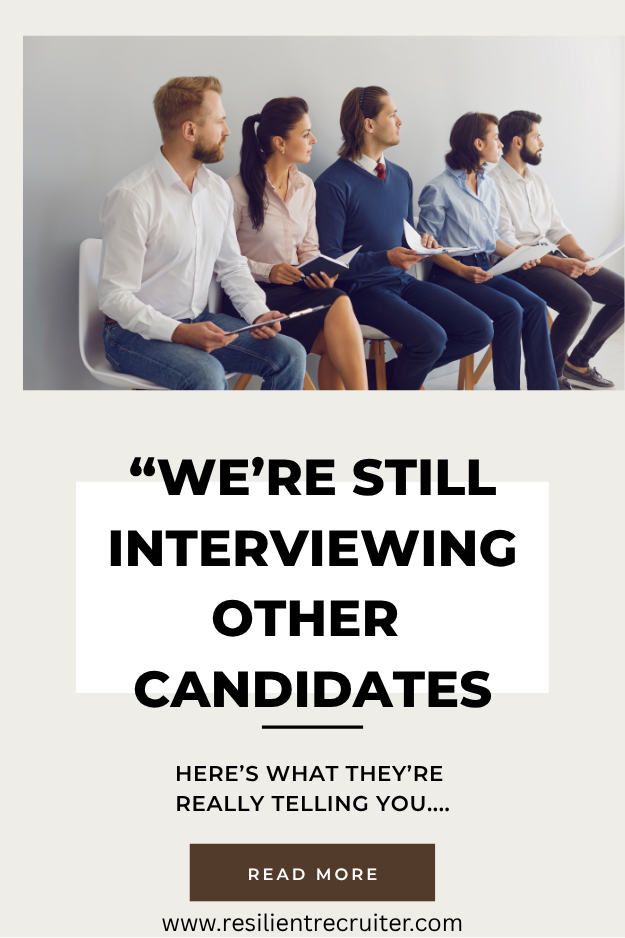
“We’re still interviewing other candidates, but we’ll be in touch.”
It sounds reasonable. Professional…even encouraging, if you want it to be. And that’s precisely why it works so well as a deflection. After more than 25 years of recruiting across industries and seniority levels, I can tell you that this phrase rarely means what most candidates assume it means. What’s being communicated and what’s being heard are almost always two very different things.
Most candidates hear it and think: *we liked you, we’re just being thorough, sit tight.* So they wait. They replay the conversation in their heads, looking for signs of encouragement. They tell friends and family it went well. They put other opportunities on a slower track because this one felt promising. And then two weeks pass. Then three. And the silence begins to speak louder than the words ever did.
What the Phrase Usually Means
There are several possible translations for “we’re still interviewing other candidates,” and most of them are less optimistic than the phrase suggests.
**The first version is that they genuinely haven’t decided, and they’re not close.** The interview may have gone fine. You may have been perfectly qualified. But the hiring committee hasn’t reached internal alignment, and rather than tell you that the process is stalled, they’re offering you the most polished version of “I don’t know.” As I wrote in “How Hiring Committees Make Decisions Under Uncertainty”, most hiring decisions don’t resolve at the point of merit. They resolve at the point where the committee feels safe enough to commit. If they’re still interviewing, it often means no one has created that feeling of safety yet, and that includes you.
**The second version is that you’re the backup.** This is hard to hear, but it’s common. The company may have a preferred candidate who hasn’t formally accepted yet. Rather than close your file, they keep you in a holding pattern, not because they’re seriously considering you, but because they need an insurance policy in case their first choice falls through. It’s pragmatic on their end. It is also disrespectful of your time, and most companies don’t lose sleep over that.
**The third version is that it’s already over, and nobody wants to be the one to say it.** The decision has been made. Someone else got the nod, or the committee realized you weren’t the right fit, or an internal candidate surfaced who had the institutional trust and proximity that no external candidate can replicate. I explored this dynamic in detail in “Why Companies Sometimes Interview Candidates They Never Planned to Hire”. This phrase lets them close your file without the discomfort of a direct rejection. It’s one of the most demoralizing realities of modern hiring, and it happens far more frequently than most job seekers realize.
Why Companies Default to This Phrase
The reason “we’re still interviewing other candidates” has become the universal placeholder is that it protects the company without requiring any vulnerability or specificity. It doesn’t reject you OR commit to you. It keeps the relationship technically alive without requiring any actual follow-through.
Employment attorneys have trained organizations to say as little as possible during the evaluation stage because specificity creates liability. So instead of telling you where you stand, they tell you where the process stands. It feels like information. It isn’t.
And in a hiring environment where ghosting has reached a three-year peak (Fortune reported earlier this year that 53% of job seekers experienced ghosting within the past year, up from 38% in 2024), this phrase often functions as the last thing a candidate hears before silence takes over entirely.
What You Should Do When You Hear This
First, take the statement at face value, but not at hope value. It is entirely possible that they are still interviewing and that you remain a strong contender. It is also entirely possible that you’ve already been mentally moved to the “not this time” pile and no one has gotten around to telling you yet.
Second, do not slow down your search. This is the single most expensive mistake candidates make after a promising interview. If you stop moving because one company gave you a warm feeling and a vague timeline, you’ve handed your power to a process you don’t control. I wrote about this specific pattern in “Job Paralysis Is Real. And It Has Nothing to Do With Being Lazy”, and it applies here just as strongly. Momentum matters more than any single opportunity.
Third, follow up once with a specific, forward-looking message. Not “just checking in.” Not “wanted to see where things stand.” Something that reinforces your fit and references something discussed in the interview. Then move forward. If they want you, they’ll find you.
And fourth, recognize the pattern. If you’re hearing this phrase repeatedly across multiple processes, the issue may not be with the companies. It might be a signal that your interviews are landing in the “qualified but not compelling” zone, and that’s something you can absolutely address. “What Employers Mean by ‘Fit'” breaks down what that gap often looks like and how to close it, and “Why Being Qualified Is No Longer Enough” explores the broader shift in how hiring committees evaluate candidates in 2026.
My Closing Thoughts
“We’re still interviewing other candidates” is not a status update. It’s a holding pattern, and more often than not, it’s one that favors the company’s comfort over your clarity.
The professionals who move through today’s hiring landscape with the least damage are the ones who learn to hear what’s being said between the lines, and who refuse to let someone else’s indecision become their paralysis. A genuine consideration comes with specifics: a timeline, a follow-up call, another round. Vague language with no next step is almost always telling you something the person saying it doesn’t want to say directly.
Let’s Talk About This
I’d love to hear your experience with this phrase. Were you ever told “we’re still interviewing other candidates” and then heard nothing for weeks? Or did the company genuinely come back with an offer? What helped you decide when to wait and when to move on?
Drop a comment below. The more honest this conversation gets, the more useful it becomes for everyone navigating it.
If you want a clearer, more strategic framework for reading the room during interviews and understanding what’s really being decided after you leave, my Modern Interview Playbook walks you through all of it.
I share what recruiters know that job seekers deserve to hear. Follow me so you don’t miss it.

by Natalie Lemons
Natalie Lemons is the Founder and President of Resilience Group, LLC, and The Resilient Recruiter and Co-Founder of Need a New Gig. She specializes in the area of Executive Search and services a diverse group of national and international companies, focusing on mid to upper-level management searches in a variety of industries. For more articles like this, follow her blog. Resilient Recruiter is an Amazon Associate.