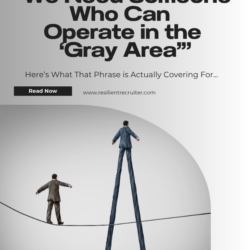
We need someone who can operate in the gray area. Here's what that phrase is actually covering for.

“We Need Someone Who Can Operate in the Gray Area.” Here’s What That Phrase Is Actually Covering For.

The Secret Language of Hiring, Part 13 It sounds like sophistication. It implies a complex environment, a high level of trust, and a role where judgment is valued over rigid process. In practice, “operate in the gray area” is covering for something specific in almost every case – and one of those versions is the[…]

"We're Just Wrapping Up Final Interviews". Here's What's Actually Happening Behind the Scenes.

“We’re Just Wrapping Up Final Interviews.” Here’s What’s Actually Happening.

The Secret Language of Hiring, Part 12 It happens right at the most anxious moment in any job search – after a final round, waiting for a decision. It sounds like forward movement and implies the finish line is close. But which version of it you actually receive determines everything about what you should do[…]

The team had some concerns. Here's what was really happening.

“The Team Had Some Concerns.” Here’s What Actually Happened in That Room.

The Secret Language of Hiring, Part 11 It feels like feedback. It implies a specific conversation took place, a standard was applied, and a thoughtful group of people weighed in on your candidacy. In almost every case, it is none of those things. Here’s what “the team had concerns” actually covers for, and how to[…]

We'll keep your resume on file - and other phrases that mean no.

“We’ll Keep Your Resume on File.” And Other Phrases That Mean No.

The Secret Language of Hiring, Part 5 There’s a particular kind of frustration that comes from a rejection that refuses to call itself one. These are the phrases that sound like they’re keeping a door open when the lock has already turned, and what you should actually do when you hear them. I want to[…]

"We decided to go in an different direction." What that actually means.

“We Decided to Go in a Different Direction.” What That Actually Means.

The Secret Language of Hiring, Part 4 It sounds like a decision was made thoughtfully. It implies you were genuinely considered. And it tells you absolutely nothing about what happened, why it happened, or what you could have done differently. Here’s what “a different direction” usually means from the inside. I want to start with[…]

"We're Still Interviewing Other Candidates". Here's What They're Really Telling You.

“We’re Still Interviewing Other Candidates.” Here’s What They’re Really Telling You.

The Secret Language of Hiring, Part 1 You prepared carefully, the conversation went well, and the feedback seemed positive. Then you heard five words that sound like a status update but almost never are. Here’s what’s actually happening on the other side of that phrase, and what it means for how you spend your time[…]

Common Career Advice That Backfires Today

The Career Advice That Often Backfires Today

Career advice has always traveled faster than career reality. Certain phrases used to be the gold standard for ensuring success in your role: “Work hard and you’ll get promoted.”“Stay loyal to your company.”“Apply to as many jobs as possible.” And for decades, this advice sounded reasonable – and those that followed it reaped its rewards.[…]

Why Overqualified Really Means Too Risky to Hire

Why “Overqualified” Really Means “Too Risky to Hire”

Few words in hiring feel as dismissive as overqualified. It usually lands without any further explanation and is rarely followed by any other feedback. It therefore leaves capable professionals questioning whether experience has somehow become a liability overnight. Most commentary treats this as insecurity on the employer’s side: fear of being outshined, threatened, or exposed.[…]

What Overqualified Really Means in Today's Hiring Market

What “Overqualified” Really Means in Today’s Hiring Market

Few phrases in the hiring process generate as much confusion as “overqualified.” It sounds like praise, but it functions as a full stop. Candidates are left wondering how experience, judgment, and capability – the very qualities careers are built on – suddenly became liabilities. Most explanations offered to candidates are superficial. Employers worry you’ll get[…]

Why Interview Feedback is Vague - and Why it Usually Has to Be

Why Feedback Is Vague – and Why It Usually Has to Be

For many candidates, the most frustrating part of the hiring process is not rejection itself. It is the explanation. After multiple interviews, careful preparation, and weeks of waiting, candidates are told some variation of the same thing: “It was a competitive process.” “We went in another direction.” “There was nothing wrong; it just came down[…]

Why Interview Feedback Rarely Tells You What You Need to Know

Why Interview Feedback Rarely Tells You What You Need to Know

Interview feedback is often treated as a diagnostic tool. Candidates expect it to explain what went wrong, what should change, and how to improve the next time. When the feedback they receive feels vague or repetitive, many assume it is evasive, overly cautious, or deliberately unhelpful. That assumption is understandable. It is also largely incorrect.[…]

Social media & sharing icons powered by UltimatelySocial