
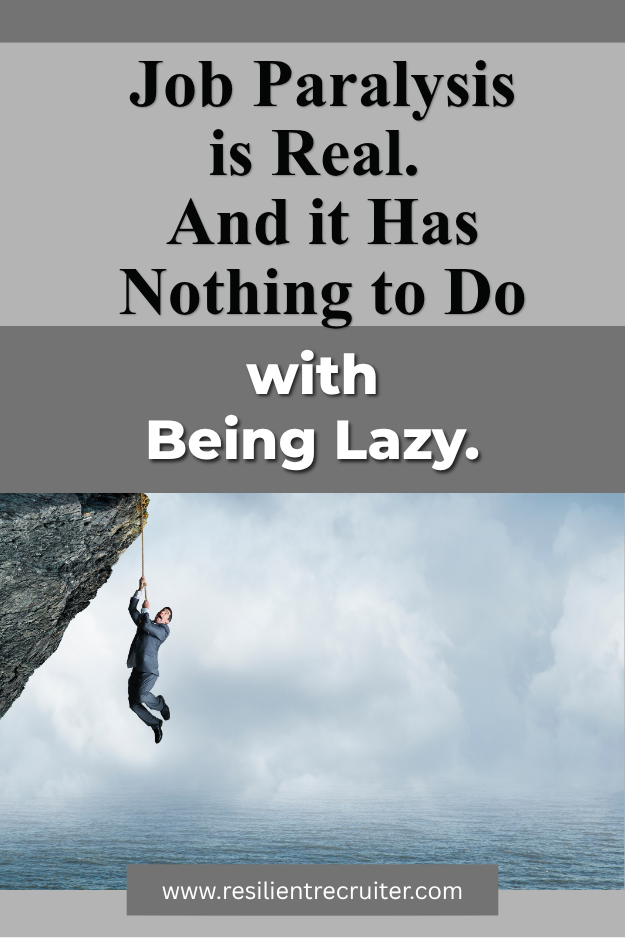
The number of people who want to leave their jobs has never been higher. The number actually doing something about it has never been lower. Here’s why that gap exists – and what it’s costing people who wait.
A year ago, I was talking to a professional with nearly two decades of experience in her field. Smart, accomplished, well-regarded by anyone who had ever worked with her. And completely frozen.
She told me she knew she needed to leave her job. She had known it for almost a year. The culture had shifted. Her manager had changed. The role she once genuinely loved had gradually become something she dreaded on Sunday afternoons. And yet every time she sat down to update her resume or reach out to a contact, something stopped her. Tell herself she’d do it tomorrow. And tomorrow would come and go.
She wasn’t lazy – or indecisive. She was experiencing something that has no official name in recruiting or career circles. I’ve started calling job paralysis: the state of wanting out badly enough to feel it every day, but being too afraid of the current environment to actually move.
If that sounds familiar, you are not alone. And it is far more widespread than most people realize.
The Numbers Tell a Story That Feels Personal
Here’s a number that stopped me cold when I saw it. In 2025, 93% of workers said they planned to look for a new job. One year later, that number had fallen to 43%. A fifty-point collapse in search intent in twelve months.
That data comes from Monster’s 2026 WorkWatch Report, a national survey of over 1,500 employed U.S. workers. At almost the exact same time, FlexJobs’ 2026 State of the Workplace Report found that the share of workers who had either recently quit or were seriously thinking about quitting had climbed to 41%, up from 33% the year before. So the desire to leave is growing. The follow-through has almost completely evaporated.
Researchers from MyPerfectResume, whose findings were covered by HR Executive, identified four specific fears driving what they formally labeled “job paralysis” this year: inflation and cost-of-living pressure, mental health challenges, fear of unemployment, and stalled salary growth. Together, these concerns have pushed more than 65% of workers to say they won’t be actively searching in 2026. The researchers described this as workers choosing security over ambition – job stability over exploring better options.
That framing itself tells us about the motivation of these professionals. These people aren’t lazy, nor do they lack confidence. It has become a rational response to a market that has genuinely shifted the risk calculus for millions of professionals, many of whom have been burned before and aren’t eager to walk back into that experience voluntarily.
Why the Current Market Feels Different From Every Other Moment of Uncertainty
I’ve been in recruiting long enough to have watched professionals navigate post-9/11 uncertainty, the 2008 recession, and the whiplash of COVID. Each of those moments created fear. Each of them also, eventually, subsided. You knew the market was bad, so you adjusted, waited, or you moved.
What’s different right now is that the signals are genuinely mixed in a way they haven’t been before. The headline unemployment rate looks reasonable. And yet, per Glassdoor’s 2026 Worklife Trends Report, average career opportunity ratings have been falling steadily for remote and hybrid workers. Words like “disconnect,” “distrust,” and “misalignment” are appearing 25–149% more frequently in employee reviews than they were just a few years ago. Hiring timelines are stretched. Ghost jobs – real postings for roles companies aren’t actually ready to fill (and sometimes jobs companies have no intention of filling) – have become common enough that researchers estimate they represent between 18 and 22% of all online listings.
For a professional sitting inside that environment trying to make a rational decision about their career, the math is confusing. The market doesn’t look catastrophic, but it doesn’t feel safe either. And that ambiguity, more than outright bad news, is what tends to produce paralysis.
Research from the American Psychological Association has documented that uncertainty paired with high personal stakes depletes decision-making capacity faster than almost any other condition. When you genuinely can’t predict the outcome, the brain defaults to inaction. It’s not weakness; it’s a self-protective mechanism that makes complete sense in theory, but can cost you years in practice.
The Inflation Factor Nobody Talks About Honestly
There is another layer to this that doesn’t get discussed enough in career advice circles: the financial calculus of switching jobs has genuinely changed.
For several years, the conventional wisdom was that the fastest way to get a raise was to leave. Compensation surveys backed this up. People who stayed were routinely outpaced by people who moved. Job-hopping carried a salary premium that made the risk feel worth it.
That equation has shifted. Monster’s data found that 58% of workers say their biggest fear in 2026 is that their salary won’t keep up with inflation, and another 57% say their current pay has already fallen behind. The job market is no longer reliably offering the compensation jumps that used to make the leap feel financially logical. When leaving doesn’t guarantee a raise (and might mean lower total compensation once benefits and stability are factored in) the incentive to move shrinks dramatically.
Add to that the cost of potential unemployment. A job search that takes six, eight, or twelve months now carries a real financial toll that it didn’t carry in the same way when the market was moving faster. Professionals who were laid off in 2024 know this firsthand. And for people who are still employed, watching colleagues struggle through extended searches has recalibrated their risk tolerance considerably.
This is rational behavior. The problem is that it can also become a trap.
What Job Paralysis Actually Costs You
I want to be careful here, because the last thing I want to do is add pressure to people who are already feeling it. The fear is legitimate…and the caution makes sense. But staying frozen in a role that is genuinely wrong for you also has costs, and they tend to build in ways that are easy to underestimate until they’ve accumulated significantly.
Glassdoor’s research found that average career opportunity ratings have dropped from 4.1 in 2020 to 3.5 in 2025 for remote and hybrid workers, in part because employers are increasingly prioritizing in-person presence for advancement. If you are in a role with a ceiling, waiting doesn’t raise the ceiling; it just delays the moment you confront it.
There’s also a skills visibility problem. The longer you stay in a position without moving (even laterally) the more your experience gets associated exclusively with one employer, context, and set of problems. In a market that is increasingly skills-focused rather than title-focused, that narrowing can undermine your positioning in ways that are hard to see from inside the role.
And then there is the mental health dimension. Research published in Harvard Business Review on cognitive load suggests that people don’t just suffer from overwork, they suffer from unresolved situations that their minds keep returning to. A job you know you need to leave but haven’t left is an open loop. It requires ongoing mental energy to manage: the daily recalibration of staying, the suppression of the desire to go, the low-grade anxiety of watching opportunities pass. That cost is real, even when it’s invisible on a calendar.
None of this is meant to argue that everyone should immediately storm the job boards. But it is worth asking honestly: how much of what feels like caution is actually protection, and how much is starting to cost you more than it’s saving?
The Subtle Way People Are Adapting (And What It Reveals)
One of the more interesting findings in Monster’s 2026 WorkWatch data is that people haven’t gone passive. Nearly two-thirds of workers say they are pursuing extra income streams: 32% already holding a side hustle, and another 30% planning to start one this year. Workers are not giving up on improving their financial situation. They’ve simply detached the thought of income growth from their primary employer.
That’s a meaningful shift. For a long time, the dominant career script was: dissatisfied? Move to a new job. Now the script has fragmented. People are building financial resilience outside their main role, developing skills in parallel, and keeping their options open without committing to a formal search.
From a career strategy standpoint, this has some real advantages. Skills developed through freelance or consulting work show up on resumes and LinkedIn in ways that shift long-term positioning. Projects completed outside a corporate role demonstrate initiative and capability in a form that interviews can actually surface – not to mention time management capabilities. Some of the most compelling candidates I speak with are people who started something on the side not because they were entrepreneurial by nature, but they needed an outlet for skills their primary role wasn’t using.
The risk is when the side hustle becomes a substitute for a decision that actually needs to be made; when parallel income becomes a reason to stay indefinitely in a role that has genuinely run its course.
How to Move Through This Without Pretending the Fear Isn’t Real
Here’s what I’d offer to anyone who recognizes themselves in this conversation.
First: make a point to identify it. Job paralysis has a specific feel – it’s not the same as uncertainty about direction, or burnout from too many applications. It is the specific experience of knowing you want to move and being unable to. When you name it accurately, you stop diagnosing yourself as someone who lacks ambition or discipline. You start understanding what you’re actually navigating.
Second: reduce the activation energy. The biggest mistake I see is people treating job searching like a binary – either fully in or not in at all. That separation makes it feel enormous, therefore something to avoid. You can update your LinkedIn headline without applying anywhere. You can have one coffee conversation without committing to a search. You can refresh your resume without posting it. Incentive to search builds from small actions that don’t require you to bet the whole thing at once.
Third: get honest about your actual timeline. The professionals I’ve watched navigate this most effectively are the ones who ask themselves: if nothing changes in the next twelve months, how will I feel about that? Not next week – twelve months (or even more). That question tends to clarify things that daily discomfort can obscure.
Fourth: remember that the market is uneven. The headline data about a difficult job market is very real, but it applies unevenly. There are industries and roles and companies hiring with urgency right now. There are searches moving quickly for the right candidates. A difficult market is not a closed market, and treating them as equivalent leads to decisions (or non-decisions) that don’t reflect actual opportunity.
And finally: if you’re going to search, search with intention rather than volume. The spray-and-pray approach doesn’t work well, even in strong markets. In this one, it’s a recipe for the exact kind of rejection accumulation that produces burnout and reinforces paralysis. Targeted, well-prepared, well-networked approaches take more time upfront and produce meaningfully better outcomes.
My Closing Thoughts
The woman I mentioned at the beginning of this article? She eventually moved. It took her seven months from the conversation I described to accepting a new role, and by her own account, the first four of those months were mostly paralysis. The last three were the actual search.
What shifted wasn’t the market. It was her decision that the cost of waiting had exceeded the cost of moving. That calculation lands differently for everyone, and I don’t think there’s a universal right answer to when that moment arrives. But I do think it’s worth examining honestly, rather than letting the default of inaction make the decision for you.
The fear is real. The caution makes sense. And you are allowed to take it seriously without letting it run the show indefinitely.
I’d love to hear from you.
If you’re in the middle of this right now (or if you’ve come out the other side) I’d genuinely like to know what it felt like from the inside. What made it hard to move? What finally shifted? And for those of you who are hiring managers or recruiters: are you seeing candidates navigate this in ways that surprise you?
Drop a comment below or reach out directly. These are the conversations that are really meaningful
If you’re ready to move (or want to prepare before you are) the Modern Interview Playbook is a practical, no-fluff guide to how interviews actually work in 2026 – and how to navigate them with confidence. It won’t eliminate the fear. But it will make you considerably harder to pass over.

by Natalie Lemons
Natalie Lemons is the Founder and President of Resilience Group, LLC, and The Resilient Recruiter and Co-Founder of Need a New Gig. She specializes in the area of Executive Search and services a diverse group of national and international companies, focusing on mid to upper-level management searches in a variety of industries. For more articles like this, follow her blog. Resilient Recruiter is an Amazon Associate.