
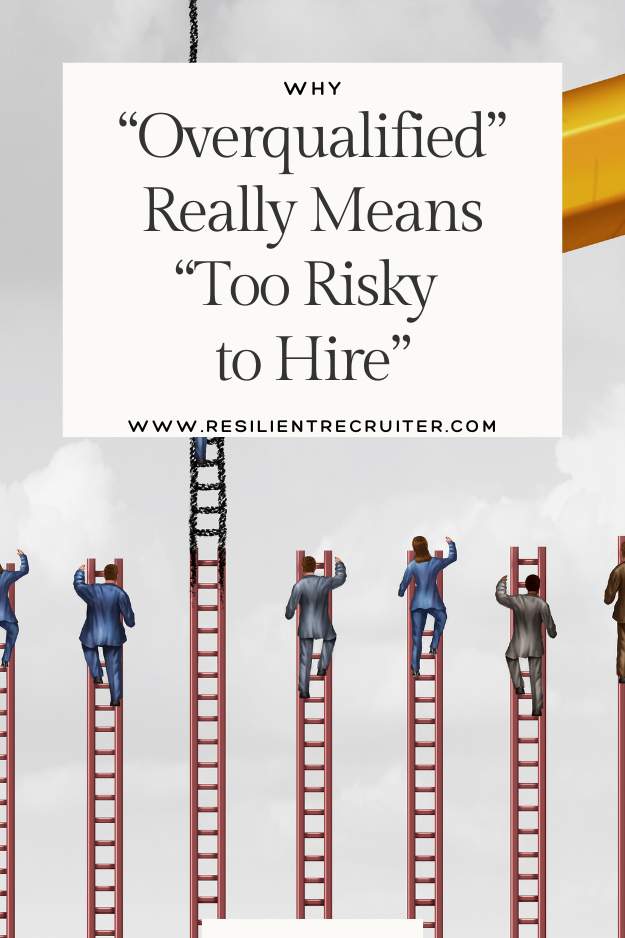
Few words in hiring feel as dismissive as overqualified. It usually lands without any further explanation and is rarely followed by any other feedback. It therefore leaves capable professionals questioning whether experience has somehow become a liability overnight.
Most commentary treats this as insecurity on the employer’s side: fear of being outshined, threatened, or exposed. That explanation is comforting, but it’s far from the whole story.
In most cases, overqualified is not a judgment about capability at all; it’s a signal about risk. As I mentioned in previous articles, averting risk is the driving factor to hiring decisions in today’s job market.
What Hiring Teams Actually Mean When They Say “Overqualified”
Hiring decisions are rarely made in isolation. They’re shaped by internal alignment, future uncertainty, and how defensible a choice will be once the hire is made. When a candidate is labeled “overqualified,” the unspoken concern usually isn’t, “Can they do the work?” It’s, “What does hiring them commit us to?”
Research from Harvard Business Review on hiring under uncertainty shows that organizations become cautious when a candidate’s experience suggests outcomes the role itself cannot yet support: expanded scope, increased authority, or accelerated expectations. This means the issue isn’t necessarily excess skill.
It’s role elasticity.
Role Elasticity and Why It Matters More Than Fit
What does that mean? It means every role has an implicit range: how much it can stretch before it changes shape. Some roles are elastic. They can grow with the person. Others are rigid, constrained by budget, hierarchy, or organizational readiness.
When a highly experienced candidate enters a low-elasticity role, hiring teams don’t just see upside. They see tension. The immediate questions on their minds:
- Will this person become frustrated?
- Will they push for change the system isn’t ready to make?
- Will the role quietly expand in ways no one has approved?
Work from MIT Sloan Management Review on organizational design shows that misalignment between role scope and individual capacity often creates downstream disruption, even when performance is strong. Calling someone “overqualified” is often shorthand for “we can’t support what this person implies.”
Why Experience Can Increase Interpretive Risk
More experience doesn’t just add skills. It adds interpretive weight. Experienced professionals signal judgment, autonomy, and expectation. They bring history with systems, trade-offs, and decision-making (all of which are valuable, but not always welcome).
Research from INSEAD on executive hiring highlights that senior candidates introduce greater interpretive risk because stakeholders project future influence onto them. Even when the role is narrow, the candidate is read as expansive. That projection makes decisions harder, not easier. Hiring teams begin asking questions they hadn’t resolved:
- How much authority should this role really have?
- Who will this person influence?
- What happens if they’re right and we’re not ready?
When those questions remain unanswered, experience becomes a complication.
Why This Shows Up More in Cautious Markets
In uncertain hiring environments, organizations prioritize stability over potential.
Studies from McKinsey & Company on risk behavior show that during periods of ambiguity, decision-makers favor hires that preserve equilibrium rather than accelerate change. Candidates who imply movement (upward, outward, or structural) feel harder to justify. If you recall in my Modern Interview Playbook series, hiring authorities are looking for candidates that are easy to justify to their colleagues.
This is why “overqualified” appears more often in slow or cautious markets. It’s not that experience lost value. It’s that tolerance for ambiguity shrank.
Why Candidates Internalize This the Wrong Way
From the candidate’s perspective, being labeled overqualified feels personal. It sounds like:
- “You’re too much.”
- “Your career peaked.”
- “Your experience no longer fits anywhere.”
That interpretation misses the point. In most cases, the rejection has little to do with performance or relevance. It reflects unresolved decisions on the employer’s side: about scope, authority, and future direction. Many capable professionals absorb systemic hesitation as personal failure. “Overqualified” is one of the clearest examples of that misattribution.
Why Simplistic Advice Makes This Worse
Common advice in response to this problem is deeply unhelpful. Job seekers will tell me they’ve been told:
“Downplay your experience.”
“Remove senior titles.”
“Make yourself look smaller.”
That framing treats overqualification as a branding issue. It is ANYTHING but. Stripping context from experience doesn’t resolve the underlying concern. It often just increases suspicion. Hiring teams can still sense the mismatch – and now they’re unsure what else is being concealed.
Research from The Conference Board on hiring credibility shows that perceived incongruence between experience and presentation increases risk rather than reducing it.
A More Accurate Way to Understand the Rejection
Here’s a reframe that is a little more logical: being labeled “overqualified” usually means the organization hasn’t decided how much change it can tolerate. Your experience surfaced questions they weren’t ready to answer.
That doesn’t make the rejection easier. But it makes it intelligible and a little more focused. Clarity is what prevents capable professionals from rewriting their own story in response to someone else’s uncertainty.
My Closing Thoughts
“Overqualified” is rarely about excess capability. It’s about interpretive risk, role constraint, and organizational readiness.
Understanding that distinction doesn’t hand you a workaround. What it does is protect you from misdiagnosing the problem, and maybe from making career decisions based on an explanation that was never fully true.
Discussion
For those involved in hiring:
- When have you hesitated not because a candidate couldn’t do the job, but because the role couldn’t stretch to meet them?
For experienced professionals:
- Where have you sensed that your background raised questions the organization wasn’t ready to confront?
I’m interested in hearing differing perspectives.

by Natalie Lemons
Natalie Lemons is the Founder and President of Resilience Group, LLC, and The Resilient Recruiter and Co-Founder of Need a New Gig. She specializes in the area of Executive Search and services a diverse group of national and international companies, focusing on mid to upper-level management searches in a variety of industries. For more articles like this, follow her blog. Resilient Recruiter is an Amazon Associate.