The Secret Language of Hiring, Part 44
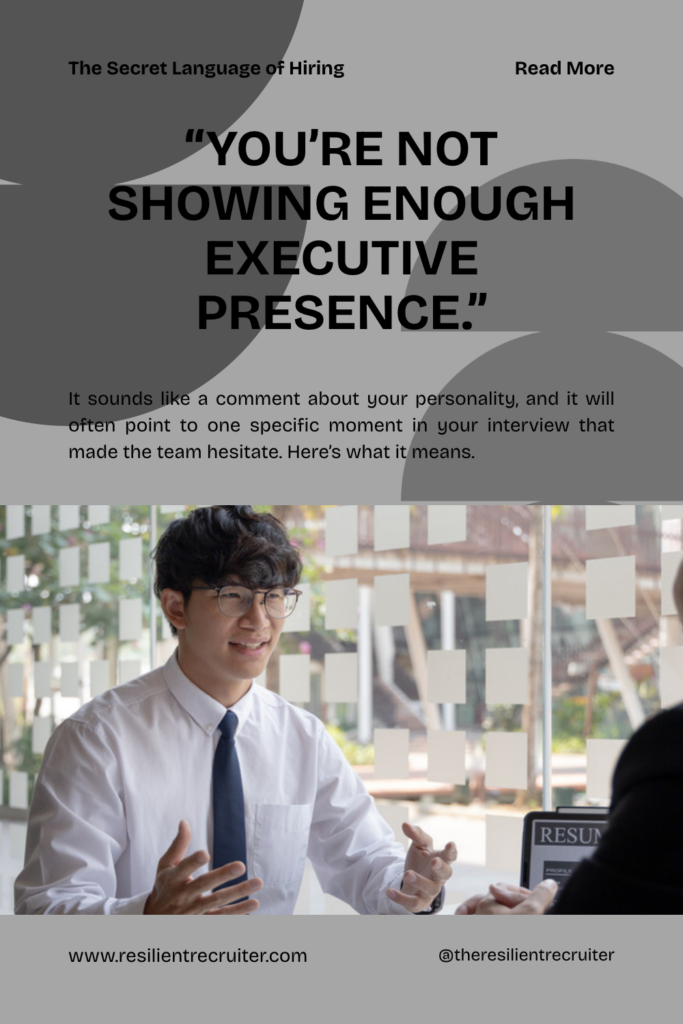
It sounds like a comment about your personality, and it will often be a hiring team’s shorthand for one specific moment in your interview that made them hesitate.
You make it to the later rounds for a senior role, you prepare carefully, and the feedback comes back through the recruiter: “The team liked your background, but they didn’t see enough executive presence.” It’s one of the most frustrating things a candidate can hear, because it sounds like a verdict on who you are rather than on anything you did.
After decades of sitting in on hiring debriefs as a recruiting firm owner, I can tell you the phrase is rarely about charisma. Research from the Center for Talent Innovation found that 67 percent of the 268 senior executives it surveyed considered gravitas the core of executive presence, with 28 percent pointing to communication and only 5 percent to appearance. Those same executives said presence accounts for 26 percent of what it takes to earn the next promotion. When a hiring team uses the phrase about a candidate, it will often mean one of three things.
Version One: Your Answers Wandered Before They Reached a Point
Interviewers for senior roles are picturing you in front of their leadership team, their board or their biggest client. If your answers took several minutes to build toward a conclusion, they may have wondered how you’d hold the attention of a busy executive who wants the headline first. The content of your answers may have been strong, but the order you delivered it in made it hard for them to imagine you presenting a recommendation and defending it.
Version Two: You Deferred When They Wanted You to Decide
This is the version I hear most often. A panel asks how you’d handle a difficult situation, and the answer comes back full of qualifiers: “It would depend,” “I’d want to get alignment first,” “I’d probably check with my manager.” Those are reasonable instincts, and in a senior role they can come across as someone waiting for permission. Hiring managers will often describe the candidate they chose as someone who took a position, explained the reasoning and stayed calm when a panelist pushed back. If you softened your view the moment someone challenged it, that hesitation is usually what the feedback describes.
Version Three: A Polite Cover for a Different Concern
Sometimes the phrase stands in for something the team would rather not say directly. They may have preferred an internal candidate, worried about your compensation expectations, or simply connected more with someone else. Feedback this vague has real consequences for the people who receive it. Shelley Correll and Caroline Simard, writing in Harvard Business Review, found that women were systematically less likely to receive specific feedback tied to outcomes, which puts them at a disadvantage when promotions are decided. If the comment comes with no example attached, you can’t assume it describes your interview at all.
What to Do Before and After You Hear It
Before your next interview, practice leading with the answer. State your recommendation in the first sentence, give two or three reasons, and stop. As I described in “How to Answer Interview Questions That Get Offers,” the candidates who receive offers will often be the ones whose answers are easy to follow from start to finish.
When a panelist pushes back, treat it as an invitation to explain your reasoning rather than a sign that you were wrong. You can acknowledge their point and still keep your position: “That’s a fair concern, and here’s why I’d still start there.” Hiring managers want to see how you respond under a little pressure, since the job will bring far more of it.
If you’ve already received the feedback, ask one narrow follow-up question through the recruiter: “Was there a specific answer or moment that gave the team that impression?” As I explained in “Why Interview Feedback Rarely Tells You What You Need to Know,” most companies limit what they share, so a single concrete example is the most useful thing you can request. If they can point to a moment, that is a good sign you can fix it. If they can’t, the concern may have had little to do with you, and as I wrote in “You Were Their First Choice. Then You Weren’t.,” decisions can turn on factors that never come up in your conversations with the team.
Executive presence will often come down to a few habits you can practice: answering with the conclusion first, taking a position, and staying steady when someone challenges it. If the feedback can’t be tied to a moment like that, you need to keep moving rather than rebuild yourself around a phrase nobody would explain.
Let’s Talk About This
Have you ever been told you lacked executive presence? Did anyone explain what they meant by it?
Drop a comment below. These experiences are impactful, and the more job seekers understand what is actually happening behind these moments, the better equipped they are to navigate them.
My free Secret Language of Hiring workbook decodes the phrases you hear throughout the hiring process, including the vague feedback that follows a final round that doesn’t go your way.
I share what recruiters know that job seekers deserve to hear. Follow me so you don’t miss it.

by Natalie Lemons
Natalie Lemons is the Founder and President of Resilience Group, LLC, and The Resilient Recruiter and Co-Founder of Need a New Gig. She specializes in the area of Executive Search and services a diverse group of national and international companies, focusing on mid to upper-level management searches in a variety of industries. For more articles like this, follow her blog
Resilient Recruiter is an Amazon Associate.
Leave a Reply